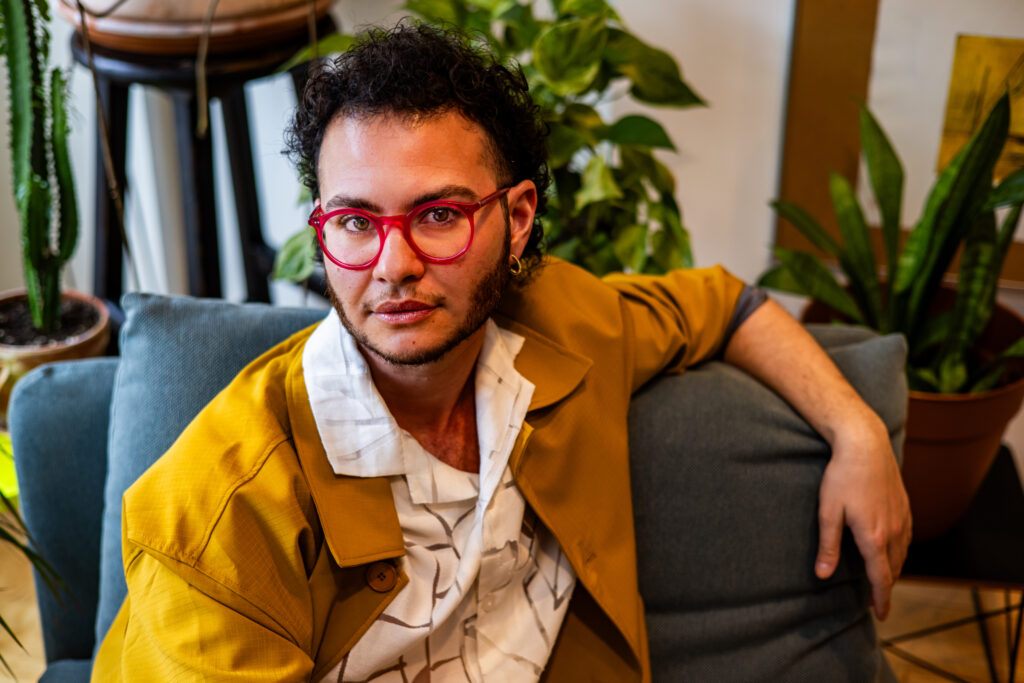
zavé martohardjono is a queer, non-binary trans, Indonesian-American artist born in Tiohtià:ke territory (Montréal, CA) in 1984. zavé grew up in the lands of the Cayuga (Ithaca, NY), Massachusett (Boston, MA), and Munsee Lenape (Queens, NY) and has lived in Lenapehoking (Brooklyn, NY) since 2006. zavé studied Political Economy at Brown University before heading to CUNY City College to study documentary filmmaking. Since 2008, zavé has been making experimental films. And since 2010, they have danced for experimental choreographers including Mariangela Lopez, J Dellecave, and Ximena Garnica among others. zavé produced community-based and devised theater with queer and trans artists and NYC activist organizations before embarking on choreographing and directing their own performance works.
zavé’s performances have been presented at the 92Y, Bemis Center for Contemporary Art, BAAD!, Bronx Museum of the Arts, Boston Center for the Arts, Center for Performance Research, EFA Project Space, El Museo del Barrio, Gibney Dance, HERE Arts, Issue Project Room, Movement Research, Storm King Art Center, Wendy’s Subway, the Wild Project, WOW Café Theater, Malastanica in Skopje, Macedonia, and elsewhere. They have exhibited at DEMO2025 at WSA, Flux Factory’s Flux IV gallery, Aljira Center for Contemporary Art, Asian Arts Initiative, Bronx River Art Center Gallery, Center for Contemporary Arts in Glasgow, George Washington University, Leonard & Bina Ellen Art Gallery, SOMArts Gallery, and Winslow Garage.
zavé has been a member of NEW INC in the Extended Realities track, a Center for Experimental Ethnography fellow at UPenn, a 2022 MRX/Movement Research Exchange program artist in Skopje, Macedonia, 2021 NYPL Dance Research Fellow, a 2019 Movement Research Artist-in-Residence, a 2020 Gibney Dance-in-Process resident, 2017-2018 LMCC Workspace Resident, a 2011 EMERGENYC artist, and has had residencies at the Bronx Museum, Shandaken: Storm King, Gibney Work Up 3.3, and Chez Bushwick. From 2017-2022 zavé was a Dance/NYC Symposium committee member.
Their work has been written about in BOMB Magazine, Brooklyn Rail, Culturebot, Hyperallergic, and The New York Times. And zavé’s writing has been published in Imagining: A Gibney Journal, The Dancer Citizen, and in We Want It All: An Anthology of Radical Trans Poetics.
Dedicated to community-driven justice, they lead social justice strategy both in and outside the art world.
ARTIST STATEMENT
I create spaces and time-based works that spark radical imagination and invite audiences to process political realities from their bodies, senses, intuition, and materiality around them. As a trans artist and activist of color, my works reflect liberatory ecosystems I am part of. A multidisciplinary artist, I make films, installations, and performances using a few core languages that trace across my works: dance, ritual, and history.
A mixed-race Indonesian-American artist, I am interested in pushing against Western assimilation and taking up ritual, mythology, and ancestral reconnection to connect legacies of colonial empire with contemporary political conditions. My film AY.EYE.AYE (2021) filmed in NYC during the Covid-19 pandemic lockdown is a slow, meditative choreopoem on time lost and gained and dance as a solitary ritual in 2020 pandemic lockdown. In the video, I dance spontaneously and alone in the open air in Lenapehoking by Brooklyn’s East River to no audience–mirroring the small, unwitnessed, impulsive dances I danced during lockdown when the field of performance was shut down. Set against images of this solitary dance and natural landscapes emptied of people which I visited for quiet walks during lockdown, a poem about ancestral communication describes personal and political grief, confusion, and rage about global crisis.
Works like my film AUTOGEOGRAPHY: A KIND OF BEGINNING (2011), my play BROTHER LOVERS (2015), and my project TERRITORY (2018-2022) experimented with timeless parables, reinventing characters from Indonesian dance-theater and epics like the Mahabharata. Queering mythological characters who feature prominently in Indonesian dance like the Barong, Rangda, and Karna and Arjuna, I pulled these archetypes out of history and placed them in contemporary times where gentrification, climate crisis, and heightened political theater is rampant. TERRITORY is dance-theater performance connecting pandemic racial justice uprisings, colonization, and climate injustice. A parable of an island suffering climate disaster is told to audiences by fierce campy global South deities who dance, invite spectators to partake in rituals, and give auntie lectures reminding them of the ancestral lineages of present-day revolutions. Looking to stories from my ancestry to grapple with present-day geopolitical questions is a way to connect past to present and unwind the colonial conditioning that limits my imagination of what futures are possible.
My most recent works are rooted in collectivity, resilience, and ecological interdependence. A settler of colour who grew up on and lives on unceded Lenape land (now known as Queens and Brooklyn, NY), I think about my role in taking care of the lands I live on and the many communities I live interdependently with—human and interspecies. My dance film LAND/ESCAPES (2023) interrogates present-day responsibilities of queer immigrant settlers on Turtle Island. In it, two dancers play, melt, and devolve in idyllic forests and crumbling colonial estates on unceded Lenape land. Cycling and stunted, they ask “Where do we go?”
ASMR4APOCALYPSE (2025) is a multifaceted project: a sound installation in a soft resting space and a dance performed in a space with biomaterial sculptures. In both, audiences can eat medicinal herbal jellies that aid their dreaming of more just futures, are encouraged to rest, and practice somatic exercises and meditative contemplation. A spatialized narrated soundtrack guides their meditation, reorienting them towards the earth’s history of transformation and regeneration across geological time (Deep Time) and their bodies’ natural ability to heal. Surrounded by bioplastic sculptures and altars, audiences are transported to envision a future where empire and our built environment will disintegrate and be rewilded to be composted into the earth. spaces I operate in so that I can insert my identity and my cultural understandings of what dance, performance, and storytelling are.
As a teaching artist, I share my artistic practices in dance workshops and courses on time-based practices using decolonial, feminist, and disability justice approaches to making. LIMINAL BODIES: Internal Practices for Unwinding Empire is a workshop drawing from a variety of artistic and healing practices (including authentic movement, Butoh, Qi Gong, Skinner Releasing Technique) and shapes these movement practices with radical, anti-colonial, feminist political education, prompting a complicated question: How can we encounter settler colonialism as well as histories of resistance to empire through our bodies — bones, organs, fluids, and flesh?
My course Decolonize Time explores contemporary artists whose time-based works radically reflect on histories and cultures erased from the lands we live on, our current embodied socio-political conditions, and point us towards decolonial, ecofeminist futures. Focused on video, film, sound, and including performance, this course considers an array of artistic practices that center marginalized collective demands, shift into perspectives aligned with geological time scale, and keep time in decolonized tempos.